
You paste an essay into a checker and get a score of 92% AI. Then you paste the same essay into another one and get 15%. That gap is the real problem with any AI essay checker, and it is why picking the right one matters before you submit a draft or grade a stack of papers.
The short answer: no free tool is perfect, but a few are consistently more reliable than the rest. The best ones show you which sentences look machine-written, not just a single number. Accuracy drops on short, formal, or non-native English writing, so treat every score as an estimate, never as proof.
Below, you'll find seven free AI essay checkers ranked by accuracy, with notes on how each handles ChatGPT-style text, what limits apply, and whether you need an account. We run AI Essay Detectors, a free sentence-level checker built on the Sapling engine, so we explain how we judged each tool and where it falls short. Use the list to find a checker that fits your draft.
1. AI Essay Detectors
Best for
Students checking their own drafts and teachers who want a quick second opinion will get the most from AI Essay Detectors. It works as a free AI essay checker with no signup, and it suits anyone who needs to see which sentences to rewrite, not just a single verdict. Editors screening guest posts can use it the same way.
How it works
You paste English text, up to 6,000 characters, and the page sends it to the Sapling detection API. Results come back in seconds. This AI detector essay checker gives you three readouts:
- Overall AI probability: the estimated likelihood that the whole text is machine-written.
- AI fraction: the share of sentences scoring 50% or higher, which helps with documents that mix human and AI writing.
- Sentence heatmap: green leans human, amber is uncertain, red leans AI.
The heatmap is the reason to use it. Once you know which three sentences are red, you can rewrite only those.
Accuracy and limitations
Because the scoring comes from Sapling's engine, our accuracy is only as good as that detector. We did not build the model. What we add is the sentence-level view and plain guidance on revising flagged lines in your own words. As an AI generated essay checker, it can misfire on short, formal, or non-native English writing, so a high score on a 150-word paragraph deserves skepticism.
A detector score should start a conversation, not end it.
Never use one result as the only basis for an academic or editorial decision. Run longer samples, compare against the writer's earlier work, and ask the author to explain their process.
Free limits and privacy
Use is free, with a daily limit per visitor and no account required. The tool also includes a word and character counter, a copy results button, and a clear button. Your text is not stored on the site. It goes only to the Sapling API to produce the result, which matters if you are checking an unpublished draft or a student's work.
2. GPTZero
Best for
Teachers and instructors get the most from GPTZero, since it was built with classrooms in mind. It also suits students who want a second opinion after running a draft through another checker.
How it works
You paste text or upload a file, and GPTZero classifies the document and highlights suspect passages. A typical report includes:
- A verdict of human, mixed, or AI.
- Highlighted sentences that look machine-written.
- A probability breakdown across the whole text.
Accuracy and limitations
GPTZero handles unedited ChatGPT output well, and that is where most detectors look their best. Heavily paraphrased AI text is harder to catch, so a low score is not a clean bill of health.
False positives are the bigger risk. Formal and non-native English writing can trip it, just as it can trip any essay AI checker.
A mixed result is a reason to ask questions, not a reason to accuse.
Free limits and privacy
A basic free plan exists, but it caps how many words you can scan each month, and some features sit behind an account. Limits change, so confirm them on GPTZero's pricing page. Read its privacy policy before pasting unpublished or student work.
3. Grammarly AI Detector
Best for
Students who already use Grammarly for grammar and style will find it convenient, because the detector sits next to the editing tools they know. It also works as a quick AI checker for essay drafts before you submit.
Teachers get less from it. The tool is built around writers checking their own work, not instructors screening a stack of papers.
How it works
Grammarly estimates what share of your text looks AI-generated and returns it as a percentage. The workflow is simple:
- Paste your essay into the detector.
- Read the percentage score.
- Rewrite the passages that worry you and scan again.
Accuracy and limitations
Detection is solid on raw ChatGPT output, but you get a coarse percentage rather than a sentence-by-sentence heatmap. Like any essay checker AI tool, it can also flag formal or non-native English writing.
A percentage tells you how much to worry, not which sentences to fix.
Free limits and privacy
The basic check is free, but length limits apply and some features need an account. Limits change, so confirm them on Grammarly's site.
Read the privacy policy before pasting a student's paper or an unpublished draft, since handling of your text depends on your settings and plan.
4. Scribbr AI Detector
Best for
Students working on essays and theses get the most from Scribbr, since the brand is built around academic writing, citations, and proofreading.
It is also a good pick if you want a quick check without an account on one section of a paper.
How it works
You paste text into the box and Scribbr returns an overall AI percentage. The process takes three steps:
- Paste a passage into the detector.
- Run the scan.
- Read the score and rewrite anything that worries you.
Accuracy and limitations
Scribbr publishes its own accuracy testing, which is more openness than most tools offer. Still, self-reported numbers deserve caution, because test conditions rarely match your essay.
Like any free AI checker essay tool, it can miss heavily paraphrased AI text and flag formal writing. Do not treat it as the best AI essay checker for every case.
A published accuracy rate is a starting point, not a guarantee.
Free limits and privacy
The free version caps how many words you can scan at once, around 500 when we last checked. Long essays need to be split into sections. Paid plans raise the limit, so confirm current numbers on Scribbr's site.
Read the privacy policy before you paste a student's paper or an unpublished draft.
5. Copyleaks AI Detector
Best for
Multilingual writers and schools or publishers screening many documents get the most from Copyleaks. It supports a long list of languages, which most free tools skip.
Individual students can use it too. It works well as an essay checker for AI text when you want a second engine to compare against your first result.
How it works
Copyleaks scans pasted text and returns an overall verdict with highlighted passages. The report typically shows:
- An estimated share of AI-written content.
- Marked sections that look machine-generated.
Accuracy and limitations
The company advertises very high accuracy, but those figures are self-reported. Independent results vary, and short or formal essays can produce false positives.
Treat a vendor's accuracy claim as marketing until your own essay backs it up.
Paraphrased AI text is the weak spot, as it is for every detector. A clean result on a rewritten draft proves very little.
Free limits and privacy
The free checker limits how much text you can scan, and an account may be required for longer documents. Limits change, so confirm them on the Copyleaks site.
Before you paste a student's paper or an unpublished draft, read the privacy policy to see how your text is handled and whether it is retained.
6. Pangram AI Detector
Best for
Editors and educators who fear false accusations will like Pangram, because the tool is built around keeping false positives low.
Writers can use it as a strict second AI essay checker on a polished draft. It works well as a tiebreaker when two other tools disagree.
How it works
You paste text into the box, and Pangram scores the whole document and marks the passages it thinks a model wrote. The report shows:
- An overall likelihood that the text is AI-generated.
- Highlighted segments, so you can see where the signal comes from.
Accuracy and limitations
Pangram's main pitch is a very low false positive rate, and it publishes technical documentation to back that up. Those figures are still self-reported, so test the tool on your own writing before you rely on it.
Short essays give any detector too little to work with, and heavily edited AI text can slip through.
A detector that rarely accuses a human writer is worth more than one that catches every machine.
Free limits and privacy
The free tier allows a small number of scans, and heavier use needs an account or a paid plan. Limits change often.
Check current limits on Pangram's site, and read its privacy policy before you paste a student's paper or an unpublished draft.
7. Originality.ai
Best for
Publishers, editors, and content marketers get the most from Originality.ai. It is built for teams that vet freelance writers and guest posts in volume. Students can use it, but it is a paid tool first and a free checker second.
How it works
You paste text or upload a document, and Originality.ai returns an AI probability score with sentence-level highlighting. A report typically includes:
- An overall likelihood that the text is AI-written.
- Highlighted passages, so you can see where the signal comes from.
- Optional plagiarism checking in the same scan.
Accuracy and limitations
The tool leans strict. That helps it catch lightly edited AI text, but it also raises the odds of false positives on formal or non-native English writing.
A strict detector catches more machines, and it can accuse more humans.
Its accuracy figures are self-reported, so test it on writing you know is human before you trust a high score.
Free limits and privacy
Most of the value sits behind paid credits, not a free plan. The free web checker caps input at a short passage, so it works as a sample check, not a full essay scan.
Confirm current pricing and limits on the Originality.ai site. Read its privacy policy before you paste a student's paper or an unpublished draft.
Choosing a checker and reading the score
The best AI essay checker is the one that fits your job. Pick a tool with sentence-level results if you plan to revise your own draft. Pick one with a low false positive rate if you are judging someone else's work.
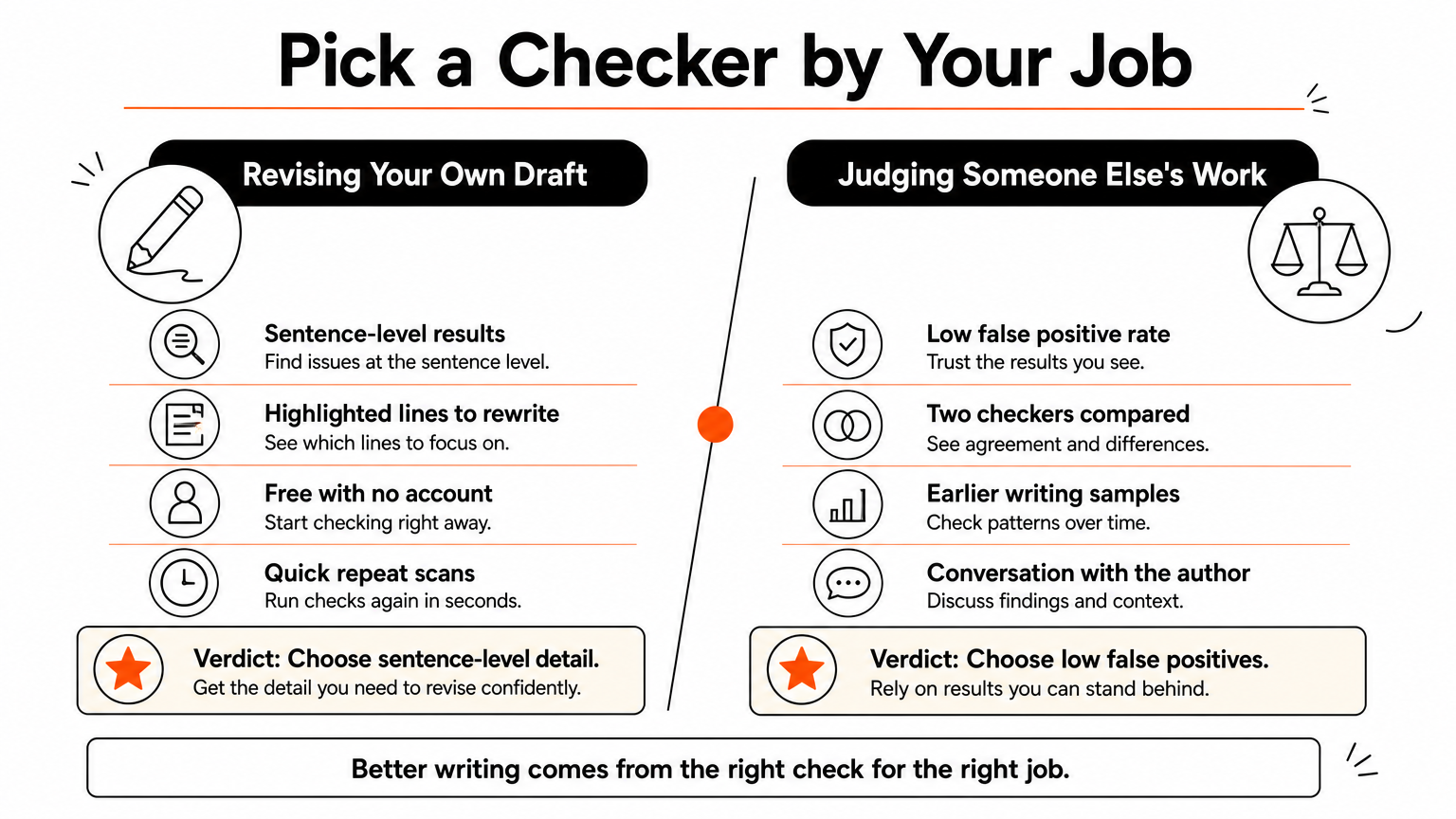
Whatever you choose, run the essay through two checkers and compare. When they disagree, like the 92% versus 15% gap we opened with, trust neither number and read the highlighted sentences instead.
Scores are statistical estimates, not proof of authorship, so learn how to read your AI detection score before acting on one. Short, formal, and non-native English writing gets flagged more often, so use a result to start a conversation, never to end one.
Ready to check a draft? Paste it into our free AI essay checker, see which sentences turn red, and rewrite those lines in your own words. It takes less than a minute and needs no account.
